
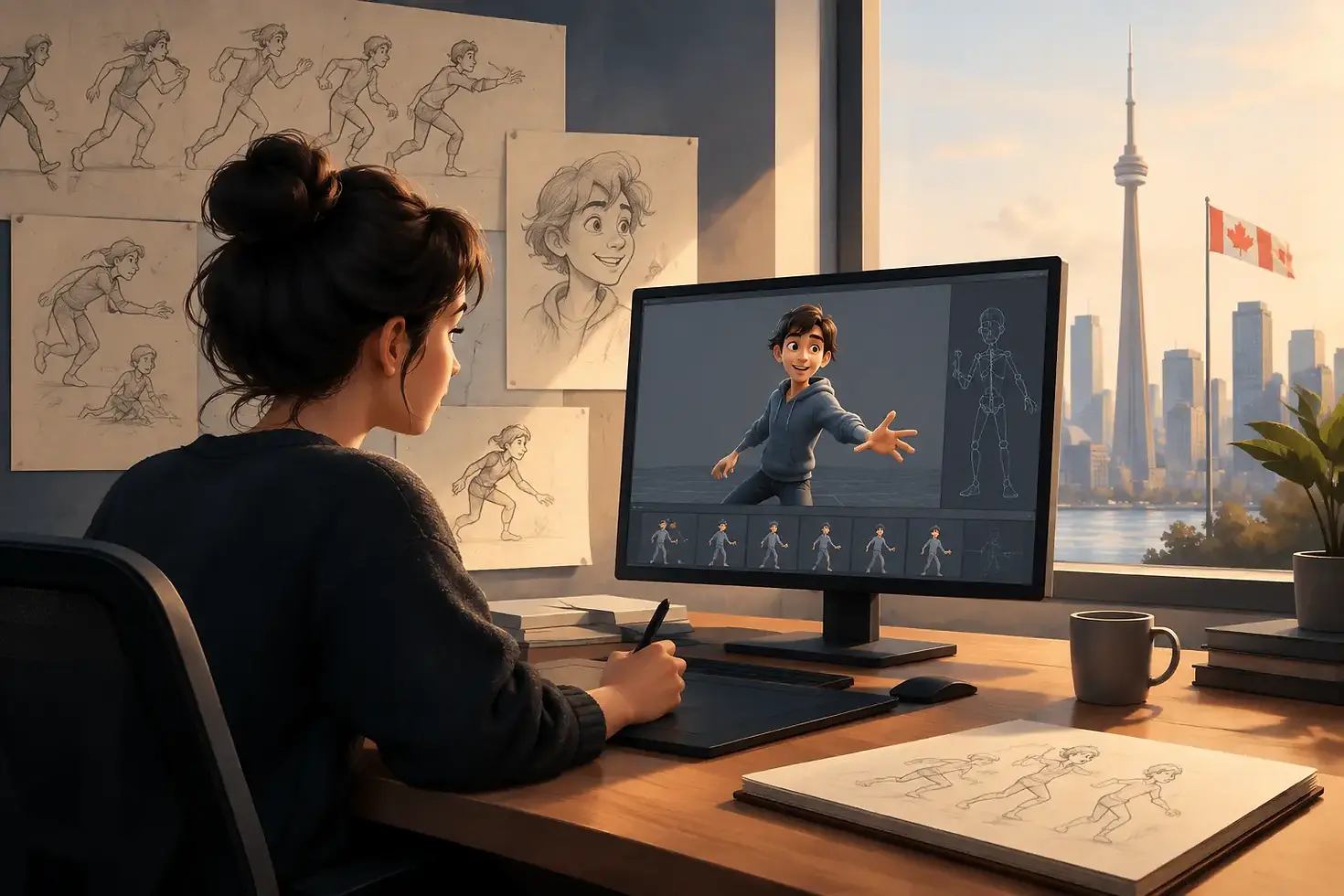
3D Character Animator Salary in Canada Explained

A job offer can look exciting on paper until you try to compare it with another studio’s contract, benefits, overtime policy, and expectations. That is why a 3d character animator salary is not one fixed number. It reflects the production you work on, the quality of your reel, your ability to take direction, and whether a studio trusts you with shots that carry real storytelling weight.
For aspiring animators, salary research is useful when it leads to a better question: what skills make an animator valuable in a professional pipeline? The strongest career decisions are not built around chasing a single salary figure. They are built around becoming capable of earning more responsibility over time.
What does a 3D character animator salary look like in Canada?
In Canada, a junior 3D character animator entering television, film, or game production may commonly see annual salaries in the range of roughly $50,000 to $65,000 CAD. Animators with several production credits and dependable shot work often move into a range of approximately $65,000 to $85,000. Senior animators, leads, and specialists can earn $85,000 to $110,000 or more, particularly on larger productions or in high-demand roles.
These are broad working ranges, not guarantees. A first role may be a short-term contract rather than a permanent position. A studio in a major production centre may offer a higher base salary, while another employer may offer better benefits, overtime terms, remote flexibility, or a clearer path to advancement. Games, feature film, television, advertising, virtual production, and cinematics can also have very different budgets and hiring patterns.
International artists should also account for currency, local tax rules, work authorization, and whether the position is salaried, hourly, or freelance. Comparing compensation only by the headline number can hide meaningful differences.
Why salary ranges vary so widely
Character animation is a performance discipline inside a technical production process. Studios do not simply hire someone who can make a rig move. They hire animators who can interpret a brief, communicate with supervisors, manage feedback, work within a shot pipeline, and deliver believable acting on schedule.
That combination explains why two artists with the same number of years in animation can earn very different amounts. One may need extensive direction on every shot. Another may receive a sequence, identify the acting beats, solve technical problems, present clear blocking, and refine the work efficiently after review. The second animator reduces production risk, which has real value to a studio.
Experience matters, but credits matter more
A year spent practising animation is valuable. A year spent delivering approved shots in a production environment is usually more valuable in salary discussions. Production credits demonstrate that you understand deadlines, naming conventions, version control, notes, handoffs, and the reality that a shot must serve the larger sequence.
That does not mean newcomers are at a disadvantage forever. A focused demo reel can help a junior animator prove readiness before earning their first credit. Employers want evidence of fundamental control: appealing poses, clear staging, physical weight, polished timing, expressive facial work, and choices that reveal a character’s thought process.
Studio type changes the equation
Television animation may provide a strong entry point because studios often need teams that can sustain episode schedules. The pace can be demanding, and the work may call for efficient, consistent acting choices. Feature-film work may involve longer shot polish cycles and highly detailed performance expectations, but roles can be more competitive.
Game animation adds another layer. Animators may work with gameplay systems, loops, transitions, locomotion sets, combat, cinematics, or motion-capture cleanup. The salary potential can be strong, but so is the need to understand how animation functions in an interactive environment. An impressive dialogue shot alone may not prove readiness for a gameplay role.
Advertising, cinematics, and smaller studios can offer creatively varied work, although project-to-project income may be less predictable. No sector is automatically better. The right choice depends on the work you want to create, the stability you need, and the skills you want to build next.
The skills that move an animator into higher pay bands
An animator’s salary grows when their contribution expands beyond basic execution. Strong foundations are the starting point, not the finish line. Studios notice artists who consistently make sound performance decisions before a supervisor has to explain every adjustment.
Classical principles remain central to that progression. Weight, arcs, overlap, spacing, anticipation, silhouette, and timing are not academic exercises. They are the tools that make a character feel alive. Without them, even technically clean Maya work can feel mechanical.
Facial animation and lip sync can be particularly valuable because close-up performance leaves little room to hide weak choices. Animators who understand eye direction, thought changes, asymmetry, rhythm, and restraint are equipped for scenes where character and story carry the shot.
Technical confidence also affects earning potential. A production-ready animator should be comfortable working in Autodesk Maya, navigating rigs, managing scene files, troubleshooting common issues, and adapting to a studio’s workflow. Scripting, motion capture experience, Unreal Engine familiarity, or game-engine knowledge can add value in the right role, but they do not replace strong animation fundamentals.
The most dependable route to better-paying work is becoming known for three qualities: your shots are believable, your files are dependable, and your response to notes is professional. Those qualities make an animator easier to staff on important sequences.
How a demo reel influences your first offer
For a junior applicant, the demo reel often carries more weight than a resume. Studios may review dozens or hundreds of reels. They are looking for concise proof that an applicant understands character performance and can finish work to a professional standard.
A short reel with two or three exceptional pieces is usually stronger than a long reel full of unfinished ideas. Include the kind of work you want to be hired for. If your goal is feature or television character animation, a polished dialogue shot and a physically grounded body-mechanics shot can demonstrate range. If games are the target, show that you understand cycles, actions, transitions, and animation designed to read clearly during play.
Avoid hiding weak work behind fast editing, music, or cinematic camera moves. Recruiters and animation leads need to see the performance. Use simple presentation, identify your contribution when work is collaborative, and show your best material first.
Training can make a major difference here when it mirrors the conditions of real production. At Rocket Sky, students develop their work through a progressive character-animation pathway, with mentorship, proprietary rigs, Maya-based practice, and professional demo-reel development. The goal is not simply to complete assignments. It is to build evidence that you can contribute in a studio.
Salary negotiation for new and working animators
Negotiating a 3D character animator salary is not about making demands before you have context. It is about understanding the offer and communicating your value clearly. When a studio extends an offer, ask whether the role is salaried or hourly, the contract length, expected overtime, benefits, remote-work expectations, vacation pay, and the review process for raises or contract renewal.
If you have a competing offer, relevant production experience, or specialized skills that match the role, you can raise that professionally. Keep the conversation specific. Reference the responsibilities you can take on and the level of work demonstrated in your reel or credits. A respectful question such as, “Is there flexibility within the stated range based on my production experience?” is more effective than a vague request for more money.
For a first job, the highest offer is not always the best career move. A role with strong supervision, meaningful shot assignments, a healthy team culture, and a recognized credit may accelerate your growth more than a slightly higher rate on work that does not strengthen your reel. Early in your career, the quality of your next credit can influence the salary conversation after that.
Build a career, not just a starting rate
The animation industry changes from project to project, and hiring can be cyclical. That makes lasting fundamentals even more valuable. Tools will evolve, pipelines will shift, and production methods will adapt, but studios will continue to need artists who can observe human behaviour and turn it into purposeful screen performance.
Treat your first salary as a starting point, not a verdict on your potential. Build the reel that earns interviews, learn to work as part of a production team, and keep raising the level of responsibility you can handle. When your animation shows intention, clarity, and emotional truth, you are building career momentum that reaches far beyond a single offer.


Comments